Wednesday, March 14, 2007

Online Payment Services Provider (PSP)

Increasingly organizations are looking for ways to collect payment for goods and services online. To accept Credit Card Payments online you will need to obtain an Internet Merchant Account and an Online Payment Services Provider (PSP).

Online payments can be fast convenient way for your users to pay for goods and services over the Internet using their credit card, debit card or other methods. For example:
  • You may wish to accept payment for events such as conferences online
  • You may wish to fundraise via your website
  • You may have publications or other merchandise to sell

Advantages of collecting payments online include:

  • Convenience
  • Immediacy
  • Potential to reach a wider audience and hence more "customers"

UK Payment Service Providers provide software that allows card details to be processed, and acts as a gateway between your e-commerce system and the banks. The UK PSP takes payment details from your customer, checks the details with the appropriate bank, and sends the result of the check back to your system. Authorization or rejection of the transaction is completed within seconds, so you know whether or not to proceed with your customer’s order. The PSP also takes care of the final settlement of the transaction (i.e. when the money is paid into your merchant account).

Here is a UK Payment Service Provider: Axiar PSP

Wednesday, February 28, 2007

Frequency of Trading is Critical

When building or evaluating trading systems the many benefits of systems that trade very frequently are often overlooked. A system that trades frequently has many advantages over less active systems that appear to be more desirable because they have better performance ratios.

If a strategy is profitable the more it trades the more money we should make. I apologize for stating what should be obvious but you would be surprised at how often I hear discussions about selecting systems with the highest level of "expectancy" or highest "profit factor" without relating these measurements to the system's trading frequency. Simply stated, our goal should be to show the most profit with the least amount of risk and trading frequency plays a critical role in maximizing profitability and controlling our risk.

Trading frequency represents opportunity for profit. The more opportunities we can find the more profit we should expect. For example, a strategy that has a very high profit factor of 4 (profit factor is total profits divided by total losses) may not produce as much profit as a more active system that has a profit factor of only 2. Since the strategy with the lower profit factor is profitable and it has many more opportunities it may easily produce more total profit than the system with the much higher profit factor.

Active systems should give us a higher confidence level when analyzing our test data. In addition to increasing total profits, a very active system gives us much more data to analyze when doing our preliminary research. If we have a long-term trend-following strategy that produces only 50 trades over five years of data our positive results may not be nearly as reliable as the results from analyzing a more active strategy that produced 1000 trades over the same data sample. I would be willing to bet that the system with the larger sample of trades is more likely to produce profitable results in the future because our level of confidence must relate to the number of samples in our testing.

Active systems should produce more reliable results and a smoother equity curve. If we flip a coin only ten times our odds of having 50% heads and 50% tails are not very good. However if we flip the coin one thousand times we are likely to come much closer to obtaining 50% heads and 50% tails. The same logic applies to our real-time trading. If we have a large sample of real trades then our results should come closer to our expectations than if we only have a one or two trades. The active system will approach our expectations much quicker than the system that trades infrequently. If we have 50 or more trades per month with a good system we might reasonably expect to be profitable every month. However if we have a system that is only producing two or three trades per month then our monthly results will less predictable and inconsistent. The infrequent trading system might be expected to produce a profit every year but it would not be realistic to expect it to show a profit every month because the sample size in a month will be very small.
Here is a quick summary:

1. Active systems give bigger samples in testing which make the test results more reliable.
2. Active systems have more opportunity for profits and should produce more total profit over time.
3. Active systems should produce a smoother equity curve.

When setting your goals for a trading system you should give trading frequency a high priority even if it means that some of the usual performance measurements may suffer.

How to increase trading frequency:

1. Use quicker parameters for entries. Trading frequency can usually be increased in a system by using more sensitive (usually shorter) parameters for the indicators that determine the entries and exits.
2. Be aggressive when taking profits. Quicker exits that lock in profits will tend to increase the number of trades but may reduce the average profit per trade. That trade-off may prove to be worthwhile and may substantially increase the total profit over the long run.
3. Trade multiple markets. Diversification among markets should produce more trades and more consistent results.
4. Trade multiple systems. Adding more trading systems will increase the activity level. Use as many systems as you believe to be practical in terms of available capital and as many systems as you can accurately monitor.
5. Trade multiple time frames. A system that works well on daily charts may also produce positive results on hourly charts or weekly charts. Don't make the mistake of assuming that only one time frame must be used.

Here are a few final thoughts.

Drawdowns: I have found that adjusting a system to be more active will almost always increase the size of the drawdowns. However in many cases the larger drawdowns are simply the result of having a much larger sample size over the period being tested. If you perform a Monte Carlo simulation on a system that trades infrequently you will observe that larger drawdowns become more likely as the number of trades in the simulation increases. This means that your test data on the inactive system is showing an unrealistic drawdown that is probably lower than what you might expect to actually experience when trading that system over the long run. If you don't have a program to perform Monte Carlo simulations and you are analyzing a system that trades infrequently you should double the size of the historical drawdown to give you a more realistic idea of what to expect in real trading with a larger sample size.
Increased costs: Trading more often will increase your trading costs in terms of commissions and slippage. Be sure to factor in realistic costs when doing your testing. The idea of trading frequently is to make more money. At some point increased trading will begin to reduce your total profitability. You should know where that point of diminishing returns kicks in.

I'm not a mathematician but I think that system traders need a formula for comparing systems that includes the frequency of trading. (For example: Expectancy times frequency or Profit Factor times frequency.) Any other suggestions?


by Chuck LeBeau

Friday, January 19, 2007

Trailing Stops

Now that we have taken the necessary precautions to avoid catastrophic losses by using disciplined money management stops, it is appropriate to concentrate on strategies that are designed to accumulate and retain profits in the market. When properly implemented these strategies are intended to accomplish two important goals in trade management: they should allow profits to run, while at the same time they should protect open trade profits.

While their application is extremely wide, we do not believe that trailing stops are appropriate in all trading circumstances. Most of the trailing exits we will describe are specifically designed to allow profits to run indefinitely. Therefore they are best used with trend following type systems. In counter-trend trading, more aggressive exits are more suitable. The “when you’ve got a profit, take it” philosophy works best when you are trading counter-trend, since the anticipated amount of profits is limited. However, to take quick profits in a trend is usually an exercise in frustration: we exit the market with a small profit only to watch the huge trend continue to move in our direction for days or months after our untimely exit. We therefore recommend using different exit strategies based on the underlying market condition. We will discuss the more aggressive exits later; for now we will concentrate on exits designed to accumulate large profits over time.

A thorough understanding of trailing stops is critical for trend-following traders. This is because trend following is typically associated with a lower percentage of profitable trades; which makes it particularly important to capture as much profit as possible when those large but infrequent trends occur. Typical trend followers make most of their profits by capturing only a few infrequent but very large trends, while managing to cut losses effectively during the more frequent sideways markets.

The rationale behind the use of the trailing stop is based on the anticipation of occasional extremely large trends and the possibilities of capturing substantial profits during these major trends. If the entry is timely and the market continues to trend in the direction of the trade, trailing stops are an excellent exit strategy that can enable us to capture a significant portion of that trend.

The trailing stops we will describe in this and following articles have similar characteristics that are important to understand as we use them to design our trading systems. Effective trailing stops can significantly increase the net profits gained in a trend-following system by allowing us to maximize and capture large profitable trades. The ratio of the average winning trade to the average losing trade is usually improved substantially by the use of trailing stops. However there are some negative characteristics of these stops. The number of profitable trades is sometimes reduced since these stops may allow modestly profitable trades to turn into losers. Also, occasional large retracements in open trade profits can make the use of these stops quite difficult psychologically. No trader enjoys seeing large profits reduced to small profits or watching profitable trades become unprofitable.

The Channel Exit

The simplest process for following a trend is to establish a stop that continuously moves in the direction of the trend using recent highest high or lowest low prices. For example, to follow prices in an uptrend, a stopmay be placed at the lowest low of the last few bars; for a downtrend, the stop is placed at the highest high of the last few bars. The number of bars used to calculate the highest high or lowest low price depends onthe room we wish to give the trade. The more bars back we use to set the stop, the more room we give the trade and consequently the larger the retracement of profits before the stop is triggered. Using a veryrecent high or low point enables us to take a quick exit on the trade.

This type of trailing stop is commonly referred to as a “Channel Exit”. The “channel” name comes from the appearance of a channel formed from using the highest high of X bars and the lowest low of X bars for shortand long exits respectively. The name also derives from the popular entry strategy that uses these same points to enter trades on breakouts. Since we are focusing on exits and will be using only one boundary ofthe channel, the term “channel” may be a slight misnomer, but we will continue to refer to these trailing exits by their commonly used name.

For most of our examples we will assume that we are working with daily bars but we could be working with bars of any magnitude depending on the type of system we are designing. A channel exit is extremelyversatile and can work equally well with weekly bars or five-minute bars. Also keep in mind that any examples referring to long trades can be equally applicable to short trades.

The implementation of a channel exit is very simple. Suppose we have decided to use a 20-day channel exit for a long trade. For each day in the trade, we would determine the lowest low price of the last 20 daysand place our exit stop at that point. Many traders may place their stops a few points nearer or further than the actual low price depending on their preferences. As the prices move in the direction of the trade, thelowest price of the last twenty days continually moves up, thus “trailing” under the trade and serving to protect some of the profits accumulated. It is important to note that the channel stop moves only in thedirection of the trade but never reverses direction. When prices fall back through the lowest low price of the last twenty days, the trade is exited using a sell stop order.

The first and obvious question to answer about channel exits is how many bars to use to pick the exit point. For example, should we set our stop at the lowest low of 5 days or the lowest low of 20 days, or someother number of days? The answer depends on the objectives of our system. A clearly stated set of objectives for the system is always very helpful at these important decision points. Do we want a long-termsystem with slow exits or do we want a short-term system with quicker exits? A longer channel length will usually allow more profits to accumulate over a long run if there are big trends. A shorter channel willusually capture more profits if there are smaller trends. In our research, we have found that long-term systems generally work well with a trailing exit at the lowest low or the highest high of the last 20 days or more.For intermediate term systems, use the lowest or highest price of between 5 to 20 days. For short-term systems, the lowest or highest price of between 1 to 5 days is usually optimal.

Trailing stops with a long-term channel accumulate the largest open profits if there is a sustained trend. However this method will also give back the largest amount of open profits when the stop is eventuallytriggered. Using a shorter channel can create a closer stop in order to preserve more open trade profits. As can be expected, the closer stop often does not allow profits to accumulate as nicely as the longerchannel, and often causes us to be prematurely stopped out of a large trend. However, we have noticed that a very short channel length of between 1 to 3 bars is still highly effective in trailing a profitable trade in arunaway trend. The best type of channel exit to use in a runaway trend is a very short channel, for example 3 bars in length. We have observed that this exit in a strong trend often keeps us in a trade until we areclose to the end of the trend.

It appears that there is a conflict of exit objectives here. A longer channel length will capture more profit but give back a large proportion of that profit; a shorter channel length will capture less profit, but protect moreof what it has captured. How can we resolve this issue and create an exit that can both accumulate large profits, as well as protect these profits closely? A very effective exit technique calls for a long-term channelto be implemented at the beginning of the trade with the length of the channel gradually shortened as larger profits are accumulated. Once the trade is significantly profitable, or in a strongly trending move, the goalis to have a very short channel that gives back very little of the large open profit.

Here is an example of how this method might be implemented. At the beginning of a long trade, after setting our previously described money management stop to avoid any catastrophic losses, we will trail a stopat the lowest low of the last 20 days. This 20-day channel stop is usually far enough from the trade to avoid needless whipsaws and keep us in the trade long enough to begin accumulating some worthwhile profits.At some pre-determined level of profitability, which can be based on a multiple of the average true-range or some specific dollar amount of open profit, the channel length can be shortened to take us out of the tradeat the lowest low of 10 days. If we are fortunate enough to reach another higher level of profitability, like 5 average true ranges of profit or some other large dollar amount, we can shorten the channel further so thatwe will exit at the lowest low of 5 days. At the highest level of profitability, perhaps a very rare occurrence, we might even be able to place our exit stop at the previous day’s low to protect the great profit we have accumulated. As you can see, this strategy allows plenty of room for profits to accumulate at the beginning of a trade and then tightens up the stops as profits are accumulated. The larger the profits, the tighter ourexit stop. The more we have, the less we want to give back.

There is another way of improving the channel exit that is worthwhile to discuss: this is to contract (or expand) the traditional channels using the height of the channel, or some multiple of the average true range. How this might work is as follows: Supposing you are working with a 20-day channel exit. First you calculate the height of the channel, as measured by the distance between the highest 20-day high and the lowest 20-day low. Then you contract the channel by increasing the lowest low value and decreasing the highest high value previously obtained to determine the exit points. For instance, in a long trade, you could increase the lowest low price by 5% of the channel height or 5% of the average true range, and use that adjusted price as your exit stop. This creates a slightly tighter stop than the conventional channel. More importantly, it allows you to execute your trade before the multitude of stops that are already placed in the market at the 20-day low.

The last point can be considered an important disadvantage of the channel exit. The channel breakout methods are popular enough to cause a large number of entry and exit stops to be placed at previous lowest low and highest high prices. This can cause a significant amount of slippage when attempting to implement these techniques in your own trading. The method of adjusting the actual lowest low or highest high price by a percentage of the overall channel height or the average true range is one possible way to move your stops away from the stops placed by the general public and thereby achieve better executions on your exits.

by Chuck LeBeau

Monday, December 25, 2006

Forex 1-2-3 Method

This particular technique has been around for a long time and I first saw it used in the futures market. Since then I have seen traders using it on just about every market and when applied well, can give amazingly accurate entry levels.


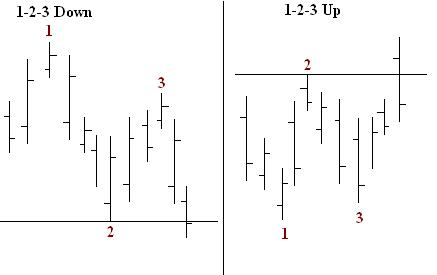
Lets first start with the basic concept. During the course of any trend, either up or down, the market will form little peaks and valleys. see the chart below:


The problem is, how do you know when to enter the market and where do you get out. This is where the 1-2-3 method comes in. First let's look at a typical 1-2-3 set up:


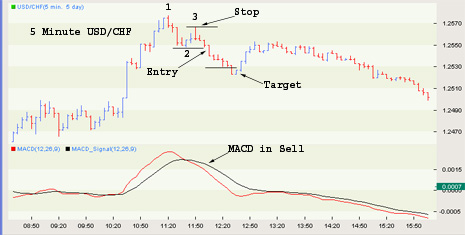
Nice and simple, but it still doesn't tell us if we should take the trade. For this we add an indictor. You could use just about any indictor with this method but my preferred indictor is MACD with the standard settings of 12,26,9. With the indictor added, it now looks like this:


Now here is where it gets interesting. The rules for the trade are as follows:

Uptrend

1. This works best as a reversal pattern so identify a previous downtrend
2. Wait for the MACD to signal a buy and for the 1-2-3 set up to be in place.
3. As the market pulls back to point 3, the MACD should remain in buy mode or just slightly dip into sell.
4. Place a buy entry order 1 pip above point 2
5. Place a stop loss order 1 pip below point 3
6. Measure the distance between point 2 and 3 and project that forward for your exit.
7. Point 2, should not be lower than point 1

The reverse is true for short trades. As the market progresses you can trail your stop to 1 pip below the most recent low (Valley in an uptrend). You can also use a break in a trend line as an exit.

Some examples:


There are a lot of variations on the 1-2-3 setup but the basic concept is always the same. Try experimenting with it on your favorite time frame.

Written by Surefire Forex Trading

Friday, December 15, 2006

A Different Type of Moving Average Cross

Virtually every trader has dabbled with or experimented with some sort of moving average. What I want to introduce you to in this lesson is a different sort of moving average cross method, which I have found to be very good at identifying short term trend changes.

As we know a moving average is normally plotted using the close of a bar e.g. if you were plotting a 3 period moving average, then you would add the last three closes and divide the total by three to get a simple moving average.

This is where I want you to think a little differently. I have always been an advocate of taking traditional thinking and changing it around. What if you used the open instead of the close? What if you used the close of one period of a moving average and the open of another?

First, most charting packages will allow you to use the open, high, low or close to plot a moving average.


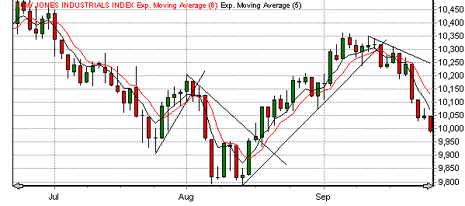
In the example below of the daily Dow Jones, I have used a 5 period exponential moving average of the close and a 6 period exponential moving average of the open. As you can see it catches the short term trend changes really nicely.


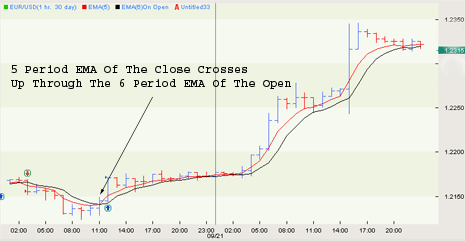
In the next example of the 1 hour EUR/USD, you can see that the close/open combination worked really well. Of course you will go through periods of consolidation with any market and any moving average method you use will be whipsawed. To get around this you need some sort of filter or approach that helps you keep out of the low probability trades.

You could use ADX, Stochastic or MACD to help filter the noise but I also like to add a time frame.


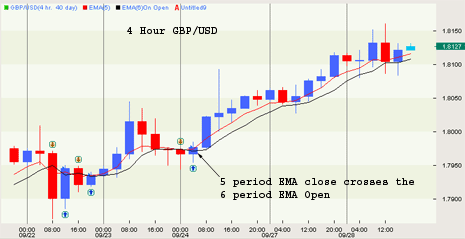
In the next example of the 4 hour GBP/USD you can see that on the 24th September 04 at 4:00 there was a cross of the 5 period exponential moving average of the close above the 6 period exponential moving average of the open. This signal has remained in place until today as I write on the 27th September.


Although there was a signal on the 4 hour, to help identify even better entry points you can drop down a few time frames to the 30 minute chart. As you can see from the 30 minute chart there have been quite a few crosses of the 5 period exponential moving of the close above or below the 6 period exponential moving average of the open.


There are lots of ways to trade this but a neat little trick is to wait for the signal on a higher time frame and then drop down a few time frames and wait for a pullback. The first signal after the pullback on the lower time frame is normally a pretty good entry point e.g. If there were a cross up on the large time frame then drop down to a lower time frame and wait for the market to retrace and then give another buy signal (cross up). The opposite is true for short signals.

Once you get the signal on the shorter time frame depending on where support is you can usually place your first stop loss under the nearest support area (valley). If the market begins to make progress you can move your stop so that it trails the market by moving your stop to just under the most recent support area.

In this lesson I have use an exponential moving average but experiment with different types of average such as weighted, smoothed or simple. You can also experiment with different lengths of moving average.


surefire-trading.com

Saturday, November 25, 2006

How To Handle A String Of Investment Losses

Everybody hates to lose and unfortunately no one is blessed with the ability of foresight, therefore losses are an unavoidable part of trading. When we enter a trade we will either be right, or wrong, and even if we broke-even we'd still be classed as being wrong - as nobody enters into a trade just to break-even! When unsuccessful traders encounter a string of losses they begin to engage in self-destructive patterns that help them escape the pain they are experiencing.

Bring to light these self-destructive actions that can help you realize what you are doing before it takes hold of your physical health. If you find yourself already engaged in these patterns hopefully this article can help you to get you back on track as quickly as possible.

What are the destructive patterns?

If you find yourself caught in a string of losses or a bad performing week/month be sure to monitor your behavior. It is during this time that you will be at your most vulnerable. You will begin to indulge in activities that at first seem harmless, but upon excessive use (or in time), begin to cause physical damage to your health.

Ask yourself the following question: during drawdown periods do I find myself over-indulging in these activities:

Food (especially junk food - e.g. chocolate, ice-cream, chips)?

Sex (includes viewing pornography)?

Alcohol?

Drugs (includes excessive smoking)?

Laziness (find it difficult to wake up in the morning)?

Entertainment?

All of the above taken in excessive doses can be detrimental to your own physical health (some even in small doses!).

These activities above during your losing period are only covering up the pain of confronting the true issue, and your body tries to rid the emotional pain by trying to "fix" it with physical pleasures. Unfortunately it is going about it in the wrong way, so what should you do?

Firstly... REALIZE WHAT YOU ARE DOING AND STOP IT!

You need to realize what you're doing and you need to STOP doing it immediately! You can either decide to stop, or you'll be forced to stop when your body eventually breaks down and prevents you from any form of movement. It will be much more beneficial to you in the long-term if you can decide to stop *NOW*.

Once you have stopped you now need to figure out a way to solve the pain - not by cutting out or neglecting it, but by staring it in the face. Bring your problems out into the light, be honest with yourself. There can be no growth without pain; you are experiencing the emotional pain, now it is time to find the error and therefore your growth.

Begin Your Review

The review process begins in two separate areas: You & Your System. Here are some checklists for you to go through to find out where the problem could lie:

"YOUR SYSTEM" CHECKLIST

Was your system thoroughly tested prior to trading it (or paper traded if you do not have the capacity to program your system into back testing software)?

Did you test with out-of-sample data?

Do you even have a system???? If you do not, how do you even know if the method that you are trading is even profitable??

Is your system's code correct?

Did you over-optimize your system? (What have we discussed about over-indulging?)

Did you paper trade your system prior to placing capital on it?

Did you trade with a small amount of capital prior to placing the rest of your funds on it?

Do you know the system's limitations?

Did you properly drill your system? (See our blog article on why I am the system designer from hell)

"YOU" CHECKLIST

Is the current drawdown you are exhibiting with your system normal?

Are you comfortable with your system's historical drawdown performance?

Are you fully aware of the risks involved with your system and the instrument(s) you are trading?

Are you trading with funds that you are comfortable risking?

Are you relying too heavily on your performance?

Have you set realistic goals?

As you can see there are generally two areas that you need to explore: the mechanical aspect - your system - and the emotional aspect - you. Both can be responsible for making the way you feel the way you do. It will either be an error on the system's side with how the system was tested and/or programmed, or it can be your own psychological profile not being comfortable with the system's performance.

Your Answers = Change = Your Growth

What steps should we now take? Now that we have begun a corrective process where we have stopped the evil nature of our over-indulging ways to take control we should continue our "corrective nature" by invoking our findings and taking ACTION in correcting our errors.

If the problem was mechanical - fix it, if the problem was emotional either go about setting up new thought patterns, or change your current system. The answers lie in whether you need to expand your knowledge in system development, or whether you need to grow emotionally as a person.

Unfortunately there is no easy road, and even if there was everybody would be doing it. Hopefully this article has made you ponder over some of your behaviors during drawdown periods, be sure to keep an eye on yourself and as always take care of your body, because there's no use in making all the money in the world when you don't have the physical capacity to enjoy it

Article Source: kokkada.com

See also:
How To Use MACD
Easy-Forex? The best trading platform available today.
Forex Trading Explained
Institutional Forex System
The MasterTrader eBook
Forex Profits

Tuesday, October 31, 2006

Combining RSI and ADX

Now that I am spending seven hours a day doing trading for the new hedge fund I haven't had much time for research or writing new Bulletins. However a comment in one of the trading newsgroups that I monitor got me thinking about the potential benefits of combining our knowledge of RSI and ADX into a simple system. Both the ADX and RSI are valuable trading tools and a combination of the two would seem to offer some interesting possibilities. I like to use the RSI primarily as an indicator for buying on dips in an uptrend. The ADX is my primary indicator of trend strength.

Here are a few ideas on how the two indicators might compliment each other in a system that "knows" when to enter on strength and when to buys on dips. (I'm only going to use the long side for examples but the logic should apply to short trades as well.)

When the ADX is rising it usually indicates that a strong trend is underway. In many cases waiting for any sizeable dip would be costly because the market could run away and the dip entry would be too late to maximize our profits. In this case we must enter on strength. To make this idea into a simple trading rule we might state that if the ADX is rising (and we have some indication it is rising because an uptrend is underway) we will buy whenever the RSI is below some very high threshold like 85. This rule would give us a very prompt entry in most cases and the result would be almost identical to simply trading whenever the ADX is rising which seems to be a good idea. The RSI has little, if any, benefit in this situation except it might occasionally keep us from buying into an extremely overbought market where the RSI was above 85. In this case a slight delay on the entry might be prudent.

The RSI, however, can play a much more important role when the ADX is flat or declining. In this case the rule would be that when the ADX is not rising we should postpone our entry until the RSI is below some more typical threshold like 45 or 50. Since the ADX is not giving us a signal that the trend is unusually strong we would need some additional indicator to show that the market has some minimal amount of upward direction. Otherwise we would not be buying a dip within the framework of an uptrend. Something simple like an upward sloping 20-bar moving average might work in this application.

Now that we have combined the ADX and RSI for our entries we might also want to combine them for our exits. When a market is rising but the trend is not particularly strong any spike in the RSI represents a good opportunity to take a profit. For example when trading in stocks the 9-bar RSI rising above 75 or 80 often signals that a correction is imminent. If the market trend is not unusually strong we would probably be happy with taking our profit on strength rather than waiting to get stopped out on weakness. However if the ADX is rising we might want to risk a correction in hopes of riding the trend even further. In this case when the ADX was rising we would ignore the RSI signal to take our profit. However, once our patience has allowed us to accumulate a very substantial open profit we might be best served by acting on the next RSI signal and nailing down the big winner. Also, when the ADX is rising it would not make much sense to be buying at a high RSI level and also selling at a high RSI level. We would be in and out of our trades almost immediately. Therefore we need to ignore the RSI extremes until our profit has had a chance to accumulate.

In summary, the important concept to remember is that our knowledge of the ADX can make the RSI a much more useful trading tool. When the ADX is rising the RSI tends to get overbought and it can often remain overbought for a surprising length of time. On the other hand when the ADX is flat or declining any spike to the upside in the RSI is an opportunity to nail down a profit. Conversely, any spike to the downside can be a potentially profitable entry point.

Here is the logic of a simple little system based on this discussion. (Just the rules in text form, you will have to do your own coding.) The parameters selected have not been tested or optimized. For example the 20-day moving average is just a number I picked out of the air. This is enough information to get you started and you can vary the rules to make the system trade over whatever time frame you prefer.

Long Entries:
1. The 20-bar moving average must be rising.
2. If the ADX is rising (ADX today is 0.20 or more higher than yesterday) then buy if the 14 bar RSI is less than 85.
3. If the ADX is not rising (ADX today is not 0.20 higher than yesterday) then buy if the 14 bar RSI is less than 50. Here is where you can influence the frequency of trading. For more trades use a higher threshold like 60. For fewer trades use a lower threshold like 40.

Long Exits
1. If the ADX is not rising (ADX today is not 0.20 higher than yesterday) then sell (long exit) if the 9-bar RSI is greater than 75.
2. If the ADX is rising (ADX today is 0.20 or more higher than yesterday) and the open profit is greater than (pick some amount - maybe 4 ATRs or some unit of price) then sell if the 9-bar RSI is greater than 75.
3. You need some additional exit rule for the losing trades. Use your favorite loss-limiting exit or you might want to exit when the price goes below the 20-dat moving average or when the 20-day moving average turns down. (See entry rule 1.)

Good luck and good trading.

by Chuck LeBeau

Wednesday, September 20, 2006

What is Technical Analysis

When trading in the foreign exchange market, part of the process involves forecasting future price movements in order to determine the best time to buy and sell. One method, called technical analysis, takes a look at the market’s past price movements to determine where the numbers will go in the future. Most investors who employ this type of analysis look mostly at price data, but sometimes information such as volume and open interest in futures contracts are also taken into consideration. If you’re just starting out in forex, the rule of thumb is to keep your methods simple - follow the basics, which have been proven over time, and only when you have gained some experience introduce more difficult techniques into your plans.

Technical analysis is almost always used on some level because price charts provide a good visual representation of the price history of a particular currency. At the very least, they can help you determine ideal entry and exit points for a trade based on the historical data. You can decide whether or not you’re buying at a fair price, selling at the top of a cycle, or entering into a shaky market.

It may seem as if adherents of technical analysis disregard market fundamentals in favor of mounds of charts and data, but they argue that these fundamentals are ingrained in the actual numbers. Something unpredictable may cause the numbers to unexpectedly spike, but you can still analyze the data, and identify patterns that will aid you in forecasting future prices.

Essentially, technical analysis can be summed up in three points. First of all, as mentioned above, technical traders assume that market fundamentals are tied to the price data. This is why factors such as the fear, hope, and mood of market participants are not contemplated directly.

Secondly, the idea that history repeats itself is core to this system of analysis. It is possible to look for patterns in price movement (called signals) because the market is predictable. When you look at past market signals you should be able to predict future signals.

Lastly, technicians rely on trends. From this analytical perspective, the market is not irregular or unpredictable. Rather, you can determine, to a high degree of accuracy, what direction a price will take: up, down, or sideways. In addition, trends are expected to continue for a period of time, making it possible to formulate predictions.

But it’s important to understand that technical analysts use more than price charts to determine good entry and exit points. Price charts are used in conjunction with volume charts, and other mathematical representations of market signals. Called studies, these additional pieces of information add another layer of data to the analysis. They let the trader look at the strength and sustainability of trends, in addition to the bare statistics.

Technical analysis is, of course, quite complicated - but for the new trader just starting out in forex, following the basics is a good place to begin. After you gain some experience and learn more about the foreign exchange market, you can delve into more complex research strategies.

Article Source: kokkada.com

See also:
How To Use MACD
Easy-Forex? The best trading platform available today.
Forex Trading Explained
Institutional Forex System
The MasterTrader eBook
Forex Profits

Friday, September 08, 2006

Short Term Analysis - September 8, 2006

AUDUSD

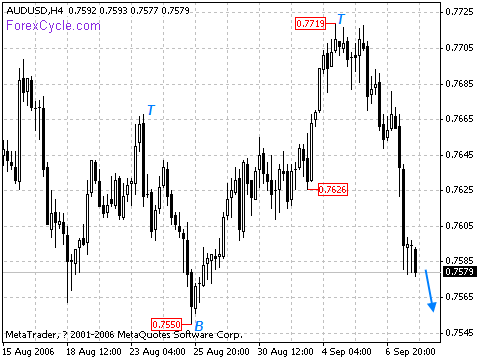
Key support at 0.7626 is broken below, AUDUSD will fall towards 0.7550 to reach the next cycle bottom. If 0.7550 support gives way, further fall towards 0.7400 area is possible in the next one or two weeks.


EURUSD

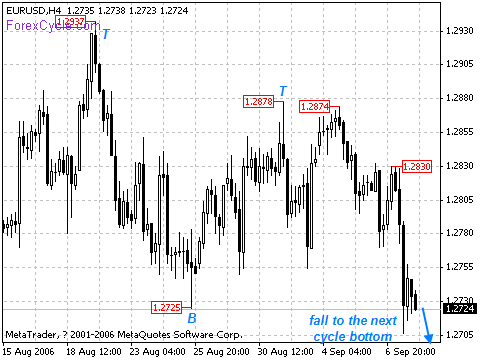
EURUSD fell below the support at 0.2725, further fall towards 1.2650 area to reach the next cycle bottom is possible in the next several days. Key resistance is now at 1.2830, break above this level may signal the cycle bottom.


USDCAD

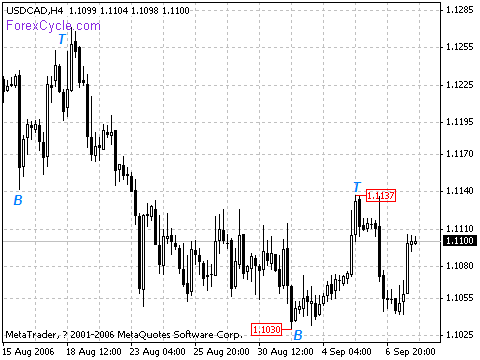
USDCAD rebound from the support at 1.1030. It is forming a sideways consolidation on 4 hours chart. Key resistance is at 1.1137, a break above this level may signal the cycle bottom at 1.1030. On the other side, if near term support at 1.1030 gives way, the pair would fall towards 1.0950.


GBPUSD

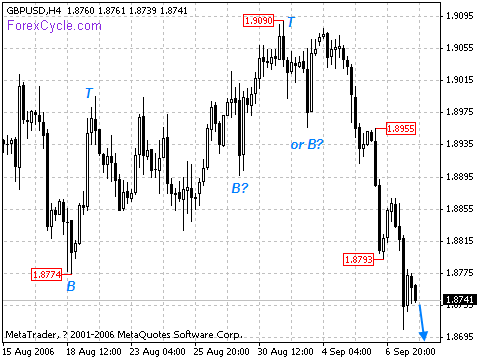
GBPUSD fall below the key support at 1.8793, further fall towards 1.8600 area to reach the next cycle bottom is still possible in the next several days. Key resistance is at 1.8955, only break above this level may signal the reversal to the down trend.


USDJPY

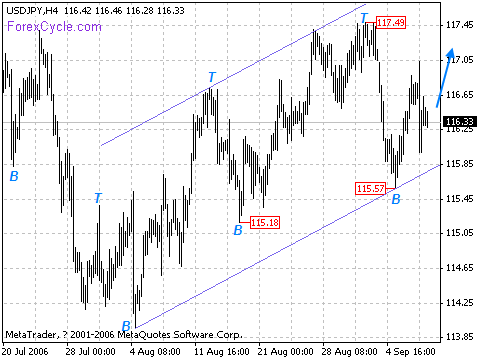
USDJPY stay in the rising price channel. Further rise above 117.49 is possible in the next several days. Key support is at 115.57, as long as this support holds, up trend will continue.


USDCHF

USDCHF rose above 1.2444. Further rise towards 1.2500 area is still possible later today. Key support is at 1.2326, only break below this level may signal the reversal to the up trend.


-------
Our server downed. We post the Short Term Analysis here temporary.

Franco
ForexCycle.com

Monday, September 04, 2006

How to stop loss

Using Stop Loss in anytime we enter the market is one way to manage our risk in trading. While some other traders might consider it as the sissy way, I don't….. I like to trade using Stop Loss. And it brings me to good results in the end of the day. Keeps me stick with well-controlled trading system.

When we decide to use stop loss, then we must be discipline in implementing it. If market price is heading so close to our stop loss, then we must not do anything. Do not ever try to replace your stop loss at further level from your open position level.

Replace your stop loss only for one reason:
For Trailing Stop Strategy (although I hardly ever use trailing stop strategy).

Now the problem is… where should we put our stop loss in each trading? Here are some tips I could give you:

1. Measure the gap between your stop loss and your open position level.
Usually I use these rules:

Eur/Usd: gap between stop loss and open position = 35 pips

Gbp/Usd: gap between stop loss and open position = 50 pips

These are representing maximum losses that you could handle in each trade. Keep that always in mind. We're not going to enter the market without this gap rule.

2. Entry strategy
Then you could predict your best entry level using your trading system. And when you decide to enter the market at certain level (using your trading strategy), do not forget to pay attention to your stop loss. Where will your stop loss be placed using the gap rule on tips #1.

Try to put your stop loss below Support Level (for Long position) or above Resistance Level (for short position).

For example:

We had Eur/Usd support and resistance levels are at:

R3 1.3052

R2 1.2962

R1 1.2906

Pivot 1.2816

S1 1.2760

S2 1.2670

S3 1.2614

Then after measuring the trend, you noticed that 1.2870 is the best place to short on eur/usd. That means, by using 35 gaps rule (see point#1), your Stop Loss would be at 1.2905.

Unfortunately, 1.2905 is not a good level to place your Stop Loss. Why? It is not protected by resistance level. When market moves upward, your Stop Loss is not well protected by its technical factor. So it would be quite easy for the market to hit your Stop Loss. Nearest resistance is 1.2906, above 1.2905. So what do we do here is to move our Stop Loss a little above 1.2905. Let's say we move it to 1.2910. Now technically, you have a well protected stop loss.

When you move Stop Loss, do not forget about the gap rule (as said in point#1). So we have to move also our open position plan.

And now, your plan becomes Short at 1.2875 (5 pips above 1.2870) and Stop Loss at 1.2910 (5 pips above 1.2905).

3. Keep calm when market heading so close to your stop loss.
Anything could happen in Forex in very short time. No one can control people madness when they enter the market. But the most important thing in dealing with this mad world is 'risk management'. Successful traders realize that sometimes they had to deal with fail trades.

So if your stop loss is hit, let it go. That's just the way it is.

Article Source: kokkada.com

See also:
How To Use MACD
Easy-Forex? The best trading platform available today.
Forex Trading Explained
Institutional Forex System
The MasterTrader eBook
Forex Profits