Friday, August 14, 2009

GBPUSD has formed a short term cycle bottom

GBPUSD has formed a short term cycle bottom at 1.6391 level on 4-hour chart. Further rise is expected later today and target would be at 1.6750 zone. Near term support is at 1.6391, below this level will suggest that the downtrend from 1.7042 has resumed, then deeper decline could be seen to 1.6000 level.
Forex Signal

Thursday, August 13, 2009

EURUSD rebounds from 1.4086

After breaking below the support of the up trend line from 1.3832 to 1.4007, EURUSD rebounds from 1.4086 and breaks above 1.4218 key resistance, suggesting that a short term cycle bottom has been formed at 1.4086 level on 4-hour chart. Range trading between 1.4086 and 1.4350 is expected in a couple of days. However, the rise from 1.4086 is more likely consolidation of downtrend from 1.4447, deeper decline to 1.3900 zone is still possible after consolidation.
Daily Forex Signals


Monday, August 10, 2009

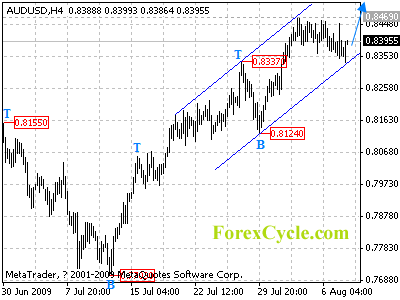
AUDUSD is testing the support of the lower border of the rising price channel

AUDUSD is testing the support of the lower border of the rising price channel, as long as channel support holds, we would expect uptrend to resume, and one more rise above 0.8469 is still possible in a couple of days. However, a clear break below the channel support will indicate that the uptrend from 0.7703 has completed at 0.8469 level already, then the follow downtrend will take price back to 0.8000 zone. Daily Forex Signals.


Friday, August 07, 2009

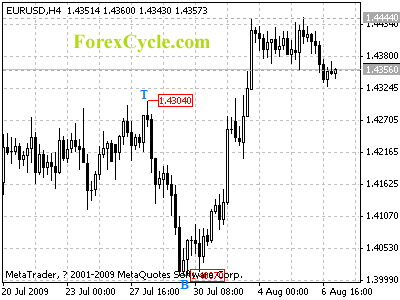
EURUSD remains in uptrend from 1.4007

EURUSD remains in uptrend from 1.4007 and the price action from 1.4444 is treated as consolidation of uptrend. Near term support is now at 1.4250, as long as this level holds, we’d expect the uptrend to resume and further rise towards 1.4600 is still possible after consolidation . However, below 1.4250 level will indicate that a short term cycle top has been formed at 1.4447, then deeper decline could be seen to 1.4150 zone. More Forex Signal


Thursday, August 06, 2009

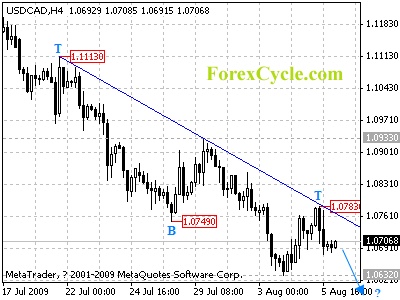
USDCAD drops from 1.0783

Being contained by the falling trend line from 1.1113 to 1.0933, USDCAD drops from 1.0783, suggesting that a short term cycle top is being formed on 4-hour chart. Deeper decline is expected to test 1.0632 previous low support later today, a break down below this level will confirm the cycle top and signal deeper decline to 1.0500 zone. Near term resistance is at the falling trend line now at 1.0765, above this level will indicate that lengthier consolidation of downtrend is underway.

Daily Forex Signal


Sunday, August 02, 2009

AUDUSD remains in uptrend from 0.6248

AUDUSD remains in uptrend from 0.6248, and the rise extends to as high as 0.8365 level. Further rally to 0.8500 zone to reach the next cycle top is still possible next week. Near term support is at 0.8100, as long as this level holds, the uptrend from 0.7703 will continue, however, below this level will suggest that a cycle top has been formed on daily chart, then pullback to 0.7800 -0.7900 area could be seen to follow.

For long term analysis, AUDUSD has formed a cycle bottom at 0.6008 (2008 low) level on monthly chart. Further rise to 0.8300-0.8500 area is still possible.


Weekly Forex Analysis

Friday, October 12, 2007

The Many Faces of the Payday Loan

There are many avenues a consumer can use to obtain a loan, each with both advantages and disadvantages. As far as the pay day loan is concerned, they are available both online and in traditional brick and mortar stores, both of which are easily found. While the gist of the loan is the same regardless of where you go, there are inherent differences in each method.

Most brick and mortar payday loan stores take your information on the spot and when you are approved, the money is given to you while you are there. The only drawback is that you may have to wait in line, whereas with online loans, this is not the case. Many people look down on the payday loan, but the fact is that these companies provide an invaluable service and provide many jobs in the community and help people out in many ways by offering many other financial services as well as the payday loans themselves.

Most often, people use the money from their payday loans for everyday expenses, but more and more savvy consumers are using this money for investments for their future. Money market accounts, CD’s, and penny stocks are just a few of the possible investment opportunities available to those who wish to start saving for the future. Payday loans can truly open up an all new dynamic for your financial future.

Tuesday, May 01, 2007

Trading with Strategy

Trading successfully is by no means a simple matter. It requires time, market knowledge and market understanding and a large amount of self restraint. ACM does not manage accounts, nor does it give market advice, that is the job of money managers and introducing brokers. As market professionals, we can however point the novice in the right direction and indicate what are correct trading tactics and considerations and what is total nonsense.

Anyone who says you can consistently make money in foreign exchange markets is being untruthful. Foreign exchange by nature, is a volatile market. The practice of trading it by way of margin increases that volatility exponentially. We are therefore talking about a very 'fast market' which is naturally inconsistent. Following that precept, it is logical to say that in order to make a successful trade, a trader has to take into account technical and fundamental data and make an informed decision based on his perception of market sentiment and market expectation. Timing a trade correctly is probably the most important variable in trading successfully but invariably there will be times where a traders' timing will be off. Don't expect to generate returns on every trade.

Let's enumerate what a trader needs to do in order to put the best chances for profitable trades on his side:

Trade with money you can afford to lose:
Trading fx markets is speculative and can result in loss, it is also exciting, exhilarating and can be addictive. The more you are 'involved with your money' the harder it is to make a clear-headed decision. Money you have earned is precious, but money you need to survive should never be traded.

Identify the state of the market:
What is the market doing? Is it trending upwards, downwards, is it in a trading range. Is the trend strong or weak, did it begin long ago or does it look like a new trend that's forming. Getting a clear picture of the market situation is laying the groundwork for a successful trade.

Determine what time frame you're trading on:
Many traders get in the market without thinking when they would like to get out, after all the goal is to make money. This is true but when trading, one must extrapolate in his mind's eye the movement that one expects to happen. Within this extrapolation, resides a price evolution during a certain period of time. Attached to this is the idea of exit price. The importance of this is to mentally put your trade in perspective and although it is clearly impossible to know exactly when you will exit the market, it is important to define from the outset if you'll be 'scalping' (trying to get a few points off the market) trading intra-day, or going longer term. This will also determine what chart period you're looking at. If you trade many times a day, there's no point basing your technical analysis on a daily graph, you'll probably want to analyse 30 minute or hour graphs. Additionally it is important to know the different time periods when various financial centers enter and exit the market as this creates more or less volatility and liquidity and can influence market movements.

Time your trade:
You can be right about a potential market movement but be too early or too late when you enter the trade. Timing considerations are twofold, an expected market figure like CPI, retail sales or a federal reserve decision can consolidate a movement that's already underway. Timing your move means knowing what's expected and taking into account all considerations before trading. Technical analysis can help you identify when and at what price a move may occur. We will look at technical analysis in more detail later.

If in doubt, stay out:
If you're unsure about a trade and find you're hesitating, stay on the sidelines.

Trade logical transaction sizes:
Margin trading allows the fx trader a very large amount of leverage, trading at full margin capacity (in ACM's case 1% or 0.5%) can make for some very large profits or losses on an account. Scaling your trades so that you may re-enter the market or make transactions on other currencies is generally wiser. In short, don't trade amounts that can potentially wipe you out and don't put all your eggs in one basket. ACM offers the same rates regardless of transaction sizes so a customer has nothing to lose by starting small.

Gauge market sentiment:
Market sentiment is what most of the market is perceived to be feeling about the market and therefore what it is doing or will do. This is basically about trend. You may have heard the term 'the trend is your friend', this basically means that if you're in the right direction with a strong trend you will make successful trades. This of course is very simplistic, a trend is capable of reversal at any time. Technical and fundamental data can indicate however if the trend has begun long ago and if it is strong or weak.

Market expectation:
Market expectation relates to what most people are expecting as far as upcoming news is concerned. If people are expecting an interest rate to rise and it does, then there usually will not be much of a movement because the information will already have been 'discounted' by the market, alternatively if the adverse happens, markets will usually react violently.

Use what other traders use:
In a perfect world, every trader would be looking at a 14 day RSI and making trading decisions based on that. If that was the case, when RSI would go under the 30 level, everyone would buy and by consequence the price would rise. Needless to say, the world is not perfect and not all market participants follow the same technical indicators, draw the same trendlines and identify the same support & resistance levels. The great diversity of opinions and techniques used translates directly into price diversity. Traders however have a tendency to use a limited variety of technical tools. The most common are 9 and 14 day RSI, obvious trendlines and support levels, fibonnacci retracement, MACD and 9, 20 & 40 day exponential moving averages. The closer you get to what most traders are looking at, the more precise your estimations will be. The reason for this is simple arithmetic, larger numbers of buyers than sellers at a certain price will move the market up from that price and vice-versa.

by Nicholas H. Bang

ac-markets.com

Wednesday, March 14, 2007

Online Payment Services Provider (PSP)

Increasingly organizations are looking for ways to collect payment for goods and services online. To accept Credit Card Payments online you will need to obtain an Internet Merchant Account and an Online Payment Services Provider (PSP).

Online payments can be fast convenient way for your users to pay for goods and services over the Internet using their credit card, debit card or other methods. For example:
  • You may wish to accept payment for events such as conferences online
  • You may wish to fundraise via your website
  • You may have publications or other merchandise to sell

Advantages of collecting payments online include:

  • Convenience
  • Immediacy
  • Potential to reach a wider audience and hence more "customers"

UK Payment Service Providers provide software that allows card details to be processed, and acts as a gateway between your e-commerce system and the banks. The UK PSP takes payment details from your customer, checks the details with the appropriate bank, and sends the result of the check back to your system. Authorization or rejection of the transaction is completed within seconds, so you know whether or not to proceed with your customer’s order. The PSP also takes care of the final settlement of the transaction (i.e. when the money is paid into your merchant account).

Here is a UK Payment Service Provider: Axiar PSP

Wednesday, February 28, 2007

Frequency of Trading is Critical

When building or evaluating trading systems the many benefits of systems that trade very frequently are often overlooked. A system that trades frequently has many advantages over less active systems that appear to be more desirable because they have better performance ratios.

If a strategy is profitable the more it trades the more money we should make. I apologize for stating what should be obvious but you would be surprised at how often I hear discussions about selecting systems with the highest level of "expectancy" or highest "profit factor" without relating these measurements to the system's trading frequency. Simply stated, our goal should be to show the most profit with the least amount of risk and trading frequency plays a critical role in maximizing profitability and controlling our risk.

Trading frequency represents opportunity for profit. The more opportunities we can find the more profit we should expect. For example, a strategy that has a very high profit factor of 4 (profit factor is total profits divided by total losses) may not produce as much profit as a more active system that has a profit factor of only 2. Since the strategy with the lower profit factor is profitable and it has many more opportunities it may easily produce more total profit than the system with the much higher profit factor.

Active systems should give us a higher confidence level when analyzing our test data. In addition to increasing total profits, a very active system gives us much more data to analyze when doing our preliminary research. If we have a long-term trend-following strategy that produces only 50 trades over five years of data our positive results may not be nearly as reliable as the results from analyzing a more active strategy that produced 1000 trades over the same data sample. I would be willing to bet that the system with the larger sample of trades is more likely to produce profitable results in the future because our level of confidence must relate to the number of samples in our testing.

Active systems should produce more reliable results and a smoother equity curve. If we flip a coin only ten times our odds of having 50% heads and 50% tails are not very good. However if we flip the coin one thousand times we are likely to come much closer to obtaining 50% heads and 50% tails. The same logic applies to our real-time trading. If we have a large sample of real trades then our results should come closer to our expectations than if we only have a one or two trades. The active system will approach our expectations much quicker than the system that trades infrequently. If we have 50 or more trades per month with a good system we might reasonably expect to be profitable every month. However if we have a system that is only producing two or three trades per month then our monthly results will less predictable and inconsistent. The infrequent trading system might be expected to produce a profit every year but it would not be realistic to expect it to show a profit every month because the sample size in a month will be very small.
Here is a quick summary:

1. Active systems give bigger samples in testing which make the test results more reliable.
2. Active systems have more opportunity for profits and should produce more total profit over time.
3. Active systems should produce a smoother equity curve.

When setting your goals for a trading system you should give trading frequency a high priority even if it means that some of the usual performance measurements may suffer.

How to increase trading frequency:

1. Use quicker parameters for entries. Trading frequency can usually be increased in a system by using more sensitive (usually shorter) parameters for the indicators that determine the entries and exits.
2. Be aggressive when taking profits. Quicker exits that lock in profits will tend to increase the number of trades but may reduce the average profit per trade. That trade-off may prove to be worthwhile and may substantially increase the total profit over the long run.
3. Trade multiple markets. Diversification among markets should produce more trades and more consistent results.
4. Trade multiple systems. Adding more trading systems will increase the activity level. Use as many systems as you believe to be practical in terms of available capital and as many systems as you can accurately monitor.
5. Trade multiple time frames. A system that works well on daily charts may also produce positive results on hourly charts or weekly charts. Don't make the mistake of assuming that only one time frame must be used.

Here are a few final thoughts.

Drawdowns: I have found that adjusting a system to be more active will almost always increase the size of the drawdowns. However in many cases the larger drawdowns are simply the result of having a much larger sample size over the period being tested. If you perform a Monte Carlo simulation on a system that trades infrequently you will observe that larger drawdowns become more likely as the number of trades in the simulation increases. This means that your test data on the inactive system is showing an unrealistic drawdown that is probably lower than what you might expect to actually experience when trading that system over the long run. If you don't have a program to perform Monte Carlo simulations and you are analyzing a system that trades infrequently you should double the size of the historical drawdown to give you a more realistic idea of what to expect in real trading with a larger sample size.
Increased costs: Trading more often will increase your trading costs in terms of commissions and slippage. Be sure to factor in realistic costs when doing your testing. The idea of trading frequently is to make more money. At some point increased trading will begin to reduce your total profitability. You should know where that point of diminishing returns kicks in.

I'm not a mathematician but I think that system traders need a formula for comparing systems that includes the frequency of trading. (For example: Expectancy times frequency or Profit Factor times frequency.) Any other suggestions?


by Chuck LeBeau